My kids love this show. We pause it and talk about it.
This one is about Prometheus and Pandora. The show leaves out the bit about Prometheus bound, having to suffer being eaten by eagles every day. That's the most interesting part, so of course I filled the boys in. They were very sorry for Prometheus.
They were pleased that Zeus let him go.
The dramatic arc of the story is simple but powerful: Prometheus stands up to power in the name of kindness and is proven justified, and in the end he is reconciled to his king. Something to that, folks...
"...being a good citizen... involves hearing the other side and making sure that you are engaging in a dialogue."
On the "certain strain of militant political correctness" sweeping college campuses the President says "And I disagree with that."
"That's a recipe for dogmatism, and I think you're not going to be as effective."
"The purpose of that kind of free speech is to make sure that we are forced to use argument and reason and words in making our democracy work. You don't have to be fearful of somebody spouting bad ideas; just out argue them. Beat 'em. Make the case as to why they're wrong. Win over adherents. That's how things work in a democracy. And I do worry if young people start getting trained to think that 'if somebody says something I don't like... if somebody says something that hurts my feelings that my only recourse is to shut them up, avoid them, push them away, call on a higher power to protect me from that..."
"You're not going to make the kinds of deep changes in society that those students want without taking them on in a full, clear and courageous way."
I'm not for hate speech, but I am for free speech. As far as I can tell this organization, the Foundation for Individual Rights in Education, is bipartisan and really lives out its principles.
You ought to be able to say unorthodox things on a college campus. Face the social consequences, sure, but things have gone to far. That's obvious.
Trigger warnings... I hope my sons never feel pressured to offer trigger warnings.
That title is deceptive. It's probably more accurate to say "Eat Like A Greek Peasant in 1820," but this is a Stoic blog, so...
My doctor recommended a book to me called "Good Food, Great Medicine." It's author, Miles Hassell M.D., uses evidence to make the case for the Mediterranean diet.
Doctor Hassell is deeply suspcicious of fad diets. Instead he bases his advice on high quality studies from peer reviewed journals. These studies teach us that the Mediteranian diet produces:
1. Lower total mortality 2. Less heart disease, artery disease and stroke 3. Les diabetes 4. More sustainable weight loss 5. Less depression 6. More active elderly people 7. Less cancer and better cancer outcomes
In broad strokes Doctor Hassell recommends that we avoid processed foods, sugar, refined grains, and hydrogenated fats.
Instead we should eat whole foods which would be recognizable 150 years ago. We should eat plenty of vegetables, fruits, nuts, and animal protien. Whole grains are fine and dark chocolate is mandatory. He advises that we drink 2-6 cups of coffee per day and one alcoholic drink (probably red wine, probably with dinner). Cheese and eggs are great.
We shall see, folks...
Hassell emphasizes simplicity in cooking. Most of his recipes seem unfussy and very doable. That's pretty Stoic.
If you're interested Wikipedia has an excellent article on Roman cuisine. Made me want to try making puls. This article claims that modern Romans eat a puls made of boiled farro grain in coffee and cream. I would not have thought of that combination.
This nice hipster lady wants to lay some science on you:
Turns out that interest in the Mediterranean diet started in Crete after World War II:
Image is by Sailko and is used under some sort of public domain license
I don't remember where I read this, but I've found it to be true.
When changing a habit the first bit is easy. It's different and that's interesting. This is the "honeymoon period."
Next comes the hard part, the "fight-through" phase. Fight-through requires will power. People often cycle through the honeymoon period and the fight-through and fail and then rinse and repeat. That's part of the process.
If you survive the fight through you have yourself a habit.
For me, Stoicism is like a habit. It's a lens through which you view the world, yes, but keeping the lens on full time is quite the feat. It's not easy.
I cut off chunks of it and then fight through until they become habits. I'm very, very far from the goal, but I am making progress.
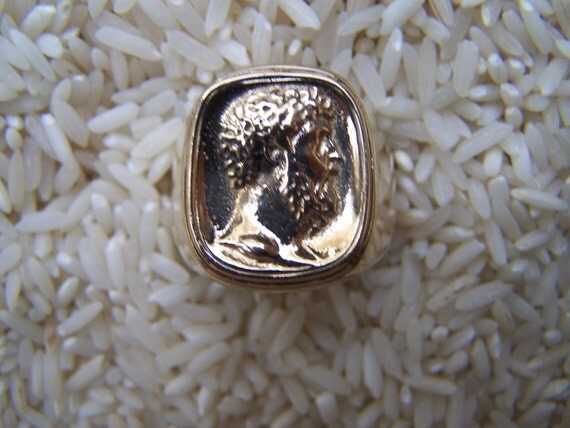
It's a great ring, custom made and sized and crafted to a high standard. I paid him sixty five dollars but he treated me as if I'd paid him a thousand. Brant is eager to please and he works quick. My highest recommendation.